In a country once dominated by cars, shared micromobility in the U.S. has become a practical and often essential part of daily life for millions of people, making commuting and errands faster—and sometimes even possible at all.
That is the central message of Veo’s forthcoming ‘Mode Shift’ report, shared exclusively with Zag Daily ahead of its release. Drawing on nationwide surveys, focus groups, and wider industry research, the report provides strong evidence that micromobility is replacing car trips in the United States. It also warns that unless cities and operators address persistent barriers, the potential of these services to reduce congestion and emissions will remain constrained.
Defining mode shift
For Veo, one of North America’s largest shared micromobility operators, the report is an attempt to quantify mode shift, a concept often invoked but rarely measured.
“Mode shift means people choosing not to take a car trip, even just once a week, because micromobility is conveniently available,” Alexander Keating, Veo’s Vice President of Policy and Partnerships, tells Zag Daily. “Most journeys in the US are under three miles and are therefore exactly the trips that bikes and scooters are well suited to replace.”
The findings highlight that micromobility is already enabling people to live with fewer cars, delay purchasing one, or avoid the cost of a second. Forty percent of Veo riders do not own a car at all, while 28% do not hold a driver’s licence. For these riders, scooters and bikes are not a lifestyle choice but an essential transport mode.
Traditionally, discussions of mode shift have focused on commuting. But commuting only makes up around a fifth of US trips. The bigger opportunity, the report argues, lies in everyday errands and social journeys: visits to friends, shops, or restaurants that are currently dominated by short car journeys.
The result is not a car-free future but a car-lite one. “We’re not talking about scrapping cars entirely. Some trips will always require them, but many don’t. Micromobility allows people to leave the car at home more often,” Alex explains.
Who is riding and why
The report challenges stereotypes of shared micromobility as a service for wealthy urban elites, or what Alex calls the “scooter-bro” stereotype. He argues that this cliche, usually associated with young, male tech entrepreneurs in Silicon Valley, is not an accurate representation of the American rider.
“Forty per cent of our riders don’t have access to a car at all, and 28% don’t even hold a driver’s licence. For them shared micromobility is a necessity, not a trend.”
Focus groups revealed that many Veo users live in outer boroughs and lower-income areas of major cities like New York. For example, riders in the Northeast Bronx and outer Queens heavily rely on shared vehicles to connect to public transport rather than to signal environmental credentials.
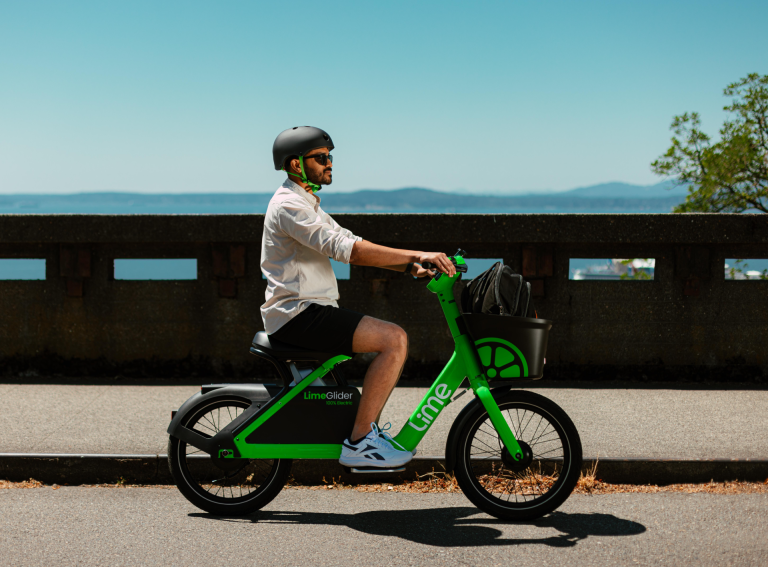
Alex adds that the type of vehicle often associated with the stereotypical “scooter bro” is also not in line with the report’s findings. Today most Veo trips are taken on seated vehicles such as e-bikes and seated scooters. These reduce barriers for women, older adults, and people with mobility challenges, broadening the user base beyond the young male early adopter.
Affordability is another key factor. Sixty percent of riders are from households earning under $50,000 a year. For them, shared micromobility provides a way to avoid the costs of car ownership, which are extensive when insurance, fuel, and maintenance are taken into account, while still accessing work, education, and social activities.
Crucially, micromobility also complements public transport. Many Veo trips are first- and last-mile connections to bus or rail stations.
“In the US, micromobility mainly strengthens transit,” says Alex. “We’re helping people use transit more effectively, not competing with it. During the day, many people pair Veo with the bus or train, and at night—when those options aren’t available—they rely on Veo instead of buying a car or calling an Uber. Together, transit and micromobility create a stronger car-free ecosystem.”
Veo co-locates vehicles at transit hubs and offers discounted connections to reduce the financial burden of a double fare.
The barriers that remain
The report identifies four persistent obstacles preventing shared bikes and scooters from scaling their impact: infrastructure, affordability, limited vehicle diversity, and restrictive service rules.
Infrastructure is the most visible. Riders are willing to use shared vehicles, but safety remains a constraint. The key, says Alex, is network planning. “A bike lane here and there isn’t enough. People need safe, continuous routes from start to finish.” Veo describes its riders as the “canary in the coal mine,” quickly proving demand whenever new protected lanes are built.
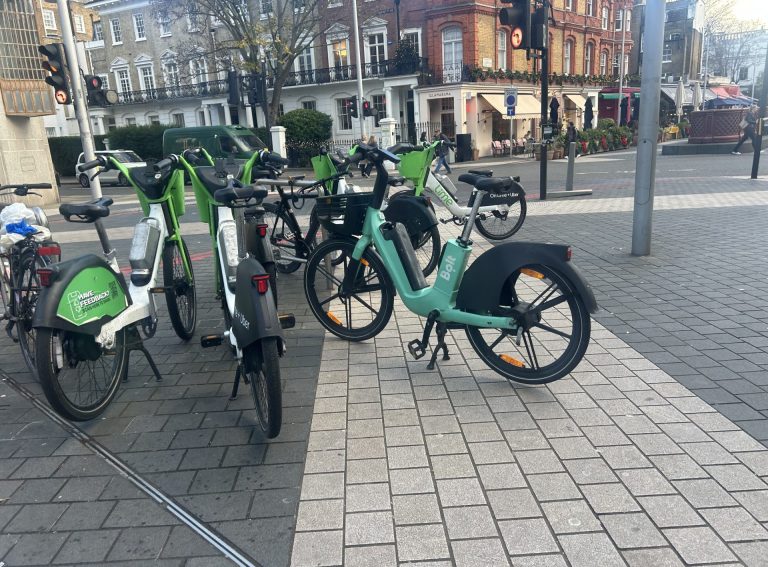
Service restrictions create further friction. Geofencing and fragmented service areas often cut across natural travel patterns, producing what Veo calls “geofence anxiety.” Vehicles pile up at no-ride boundaries while cars pass through unrestricted. This undermines reliability and deters regular use.
Affordability also remains an issue, despite the existence of discount schemes. Many eligible riders are unaware of them, reducing their impact.
A lack of vehicle diversity compounds the problem. Current fleets are optimised for solo travel, leaving out families, caregivers, and people carrying shopping or equipment. The report argues that broader fleets including cargo bikes, trikes, and adaptive options are essential if micromobility is to compete with cars for a wider range of trips.
Underlying all of this is the instability of micromobility programmes themselves. Many operate under short-term permits or pilots, discouraging both operator investment and rider confidence.
“If programmes disappear annually, riders can’t rely on them,” Alex explains. “Long-term partnerships with cities would build confidence that micromobility is here to stay.”
A call for action
The report concludes with a clear set of recommendations for cities: build safe, connected infrastructure; diversify fleets; strengthen and publicise affordability programmes; and replace short-term pilots with multi-year permits.
For Alex, ubiquity is the central requirement. “If people can’t reliably find a vehicle, they will default to cars. A city with 4,000 scooters might need 20,000 to truly shift behaviour. Getting there will require significant political will.”
The broader context is also important because with most US cities unlikely to expand public transport networks at the scale required, micromobility offers a practical way to reduce car use immediately.
By enabling short trips to be made by bike or scooter instead of car, these services can help cut congestion and emissions without waiting decades for new infrastructure.
The report’s findings are unambiguous: shared micromobility is already helping people live car-lite lives. With the right policies, its role could be multiplied.