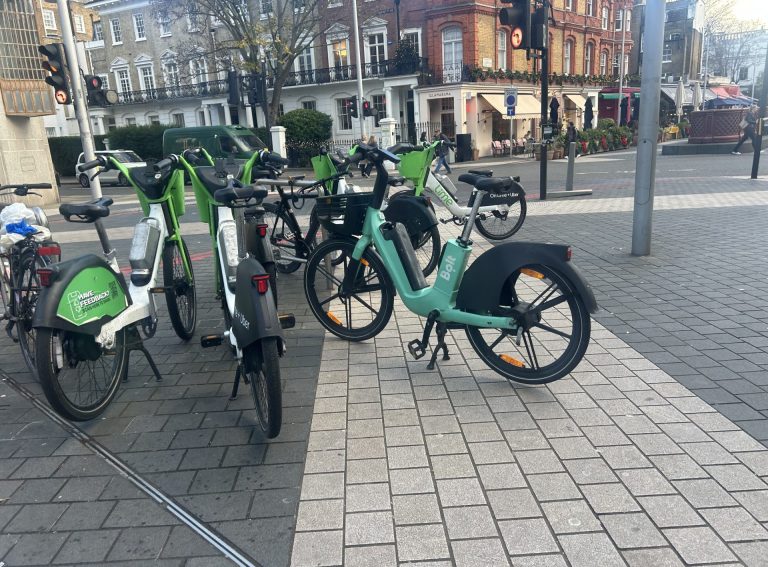
Shared micromobility operator Dott is piloting AI cameras across its e-scooter fleet to monitor rider behaviour in the UK city of Bristol.
Developed by Bristol-based AI startup Nearhuman, the cameras are mounted onto the e-scooter’s stem and collect data from the rider’s journey in real time such as road hazards, near misses and whether they ride on the pavement.
This data is then fed back to Dott and can also be converted into real-time warnings for the rider.
“Nearhuman is addressing a practical gap,” Nearhuman Founder and CEO Faizan Mir told Zag Daily. “GPS and trip records alone cannot explain whether a rider encountered a pothole, rode onto a pavement or braked sharply to avoid a pedestrian. Our retrofit modules combine onboard AI, motion sensing and location data to provide that context.”
Several use cases are envisioned by the company. Firstly, Nearhuman Co-Founder and COO Ali Ekbal said that the technology enables operators to identify pavement riding, misses with pedestrians, hazardous locations and behaviours like harsh braking and swerving. The capabilities offered by the module depend on the configuration selected by the operator.
For Dott, Head of Public Policy for the UK and Ireland Iqbal Ahmed said the “primary focus” is evaluating real-time detection of pavement riding, near-misses with pedestrians and road hazards.
“Beyond directly improving rider and pedestrian safety, this data has the potential to offer valuable street-level insights for local authorities, helping them better understand rider behavior and flow,” Ahmed said.
“Longer term, high-resolution insights like these could also support urban planning, infrastructure maintenance and safer junction design.”
For councils, Nearhuman’s aim is to support infrastructure planning and targeted interventions. This can be, for example, through identifying potholes and safety hotspots with the modules able to generate crash-event recording with location and timestamp information. Ekbal said the data could also contribute to digital twin models used to assess transport networks or individual vehicles.
Depending on configuration, what the module detects can also feed into real-time responses for the rider. If the system identifies pavement-riding or a potential hazard involving a pedestrian for example, it can send a signal to the vehicle’s control system with an audible warning or a controlled speed restriction.
For insurers, Nearhuman envisions that combining crash recordings with motion and location data will help establish what happened during an incident and support claims assessment. Ekbal said validated data means insurers will be able to assess actual operating risk “more accurately”.
Meanwhile, the cameras also aim to provide evidence about how vehicles are used and the conditions they experience. Combined with maintenance and repair records, this is envisioned to contribute to assessments of vehicle condition, remaining useful life and resale value. The startup said it has received interest from London-based Ayni which is exploring what contribution Nearhuman’s technology could have on its e-mobility intelligence platform.
Dott did not disclose how many vehicles are currently fitted with the technology in Bristol.
“This is currently a focused, initial pilot involving a select group of vehicles,” Ahmed said. “Operating at this limited scale allows us to test the technology’s capabilities, reliability and accuracy under live operating conditions before considering any broader rollout across the wider Bristol fleet.”
Ahmed added that Bristol is Dott’s “testing ground” for the time being. “But if the pilot delivers strong results, expanding across the wider fleet and into other UK or European markets is certainly on the table. We’re excited to see what the data reveals, which will guide any future expansion plans.”
Who is Nearhuman?
The pilot comes alongside a recent £350,000 pre-seed funding raise for Nearhuman to bring Physical AI to e-scooters.
Founded in 2024 by robotics-minded Faizan Mir who built a drone at the age of 14, Nearhuman aims for its technology to provide shared micromobility operators with safety insights without requiring fleet overhauls. Meanwhile, the insights around street conditions, cycle lanes and pavements can be fed back to councils for targeted interventions.
Using edge AI, the module’s AI analysis runs directly on the vehicle without relying on a cloud connection to process each scene, combining camera imagery with motion-sensor and vehicle data.
The module is designed to be retrofitted to existing vehicles, connecting to the vehicle’s internal communications network and communicating with its IoT unit and controller. It can recognise when the vehicle is unlocked and begin analysing the ride, with selected event data to then be uploaded for reporting and further analysis.
Mir said the mounting arrangement and electrical integration depends on the vehicle model. The module can work across both e-bikes and e-scooters, though integration is assessed on a case by case basis.
The camera module, called ‘Scootrr’, marks the company’s first product. Other than the Dott partnership, the startup has also engaged in technical development work with Voi, Pure Electric and Supersmith, with these relationships at “different stages, spanning development, testing and deployment”.
On-street deployment remains only in the UK for the time being, while Mir and Ekbal said the startup is eyeing opportunities to expand across Europe as the technology develops.
“No agreements have been finalised for deployment in additional UK or international markets,” Mir said. “Our immediate priority is to demonstrate reliable performance and measurable value in Bristol. Evidence from the pilot will inform discussions about larger deployments and other locations.”
Nearhuman is also developing Physical AI technologies for other applications including drones, robotics and automation. Following its pre-seed funding round, the company secured funding from UK national innovation agency Innovate UK to research new AI and foundation model capabilities.
“We expect to announce more about these technologies in the coming months,” Mir said.