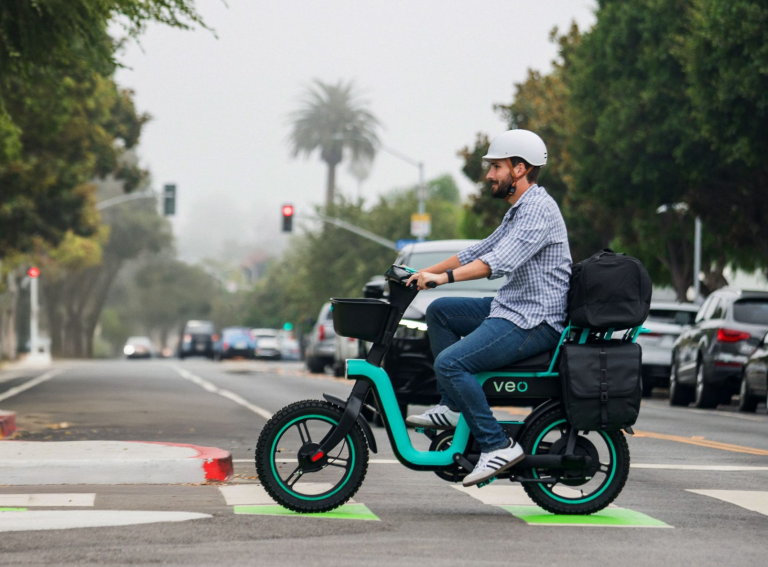
What a shared bike or scooter looks like today, how it functions and what if offers to the rider is radically different from what it was six decades ago.
Think back to the world’s first bike sharing system – Witte Fietsen, or White Bikes, in 1965 Amsterdam. This arrangement saw regular, mechanical bikes painted white and left unlocked across the city for people to ride for free. It was an honorary system which relied on little technology and a lot of trust, with the idea being that riders would pick a bike up, cycle and leave it for the next person when they’re finished.
It was built on good intentions but ended up becoming an almost instantaneous widely-regarded failure with most of the 50-modest fleet stolen and the remaining bikes fished out of Amsterdam’s canals.
Fast-forward to the 1990s and docking stations and a coin-slotting system, much resembling today’s supermarket trolleys, entered the landscape. This model which let riders slot a coin in to ride then evolved into a smart docking system where swiping a magnetic card would suffice. And then, since the 2010s, the technology largely shifted from the dock to the bike, with GPS tracking, cellular IoT and smartphone apps paving the way for the free-floating e-bike and e-scooter systems we know well today.
So, yes, it goes without saying that what shared micromobility looks like today is an entirely different story to the founding father bike share idea of Witte Fietsen. A 1960s rider perhaps could never have imagined cycling across a city with electrical assistance, let alone having a public transport card that works across both a metro and a bike and booking through a single integrated MaaS platform.
And as every corner of mobility continues to advance even further with connectivity, smart integrations and autonomy, technological advancements will certainly have a role to play in what a shared bike or scooter will look like over the next decade. But will it have the most important role to play?
Zag sits down with one of the world’s largest micromobility OEMs and two shared operators from across two continents to tackle the question in hand and examine what exactly is shaping the next era of shared micromobility vehicle design.

The OEM standpoint – Segway
Last month, Segway unveiled three brand new vehicle lines at a launch event which Zag attended in Changzhou, China. These are the R1 shared e-scooter, the C-series e-bikes and the firm’s first ever delivery model.

Segway is one of the world’s largest micromobility vehicle solution providers today. The Beijing-headquartered company has cooperated with over 250 shared operators globally and shipped more than 2.5 million shared e-bike, e-scooter and e-moped units.
After two years in the making, the new vehicle lineup unveiled in Changzhou is entirely revolved around what Segway terms the ‘OCG’ concept – operators, consumers and government.
“When I think back to preparing this new generation of scooters and bikes two years ago, there was one philosophy behind it,” Jasper Luan, Head of Segway-Ninebot’s Marketing and Solutions Department of the Commercial Mobility Business Division, tells Zag Daily.
“We need to design and build on the perspective of operators, consumers, cities and governments: the OCG. Every feature must be designed around these three perspectives.”
The concept fits into another that Segway dubbed at its Summit – ‘TCO 2.0’. TCO, or Total Cost of Ownership, refers to the combined cost of a product’s upfront purchase price with the indirect costs from operations, lifespan and disposal. It places operators at the heart of vehicle design.
But with TCO 2.0, Luan says, comes more than just considering the operator directly. It recognises that, as city licenses to operate become more specified and scrutinising, designing for city attitudes, demands and user needs helps to indirectly reduce the total cost of ownership for the operator.
“Only vehicles that are available can earn money,” Luan says. “If the vehicle is not available on the street, they become a pure cost to the operator. The first thing to think about is durability and maintenance, yes – vehicles need to be durable and easy to maintain so they can remain on the street.
“But cities also want to know that these vehicles are safe and comfortable for the rider and all road users. They want to know that operators can easily locate their vehicles and that bikes and scooters are being parked correctly. They need to know operators are in control of their vehicles. If the city doesn’t feel sure of this, it will not make these vehicles available to its citizens.”
In other words, vehicle design is not just thinking about the operator anymore. Whereas Luan recalls a time of designing “client by client” and “market by market”, he believes that designing for the best interests of the operator now means helping make the case for why these vehicles deserve to have access to public space in the first place.
And the case still needs to be made. More and more cities across Europe have demonstrated that they are unafraid to backtrack on their micromobility promises and remove vehicles from their streets if the systems don’t meet their requirements. Think Paris, Prague, Brussels and now Lisbon as one of the latest to follow suit.
Regulation is becoming more demanding. If fleets are consistently parked in the wrong place, it’s not easy to keep operating. If riders are not riding safely, the industry has seen that cities will simply not offer those vehicles to its citizens.
Zack Yan, Vice General Manager of Segway-Ninebot’s Commercial Mobility Business Division, points to micromobility’s period of consolidation as another driver of the OCG mindset, arguing that mergers and exits reflect the increasingly demanding reality of running a financially sustainable micromobility service and having a city accept it.
“Two years ago, we had around 60 or 70 big clients. Now, we have around 30 or 40,” Yan tells Zag Daily.

“Many of them have merged and that means the market is changing. Operators are coming and going. Whereas before, suppliers and operators were totally focused on the hardware, the product, the price and the end cost, we now have to think more about the reality of the operations. That means OCG. That means helping make the industry grow and, in doing so, making our customers money very directly.
“Growth isn’t just about expanding the service area or adding 10 more vehicles to the fleet,” Yan adds. “Operators must improve the quality, stability and safety of their service. This is in demand more than ever before. As I said, only half of the operators are really left.”
What does the OCG look like in a vehicle?
The technical specifications of Segway’s new vehicle lineup remain behind closed doors for now as the firm prepares for the next stages of production. More has been shared on the R1 e-scooter, however, which is being targeted for mass production next January.
“The new features are underwater,” Luan says. “You can’t see them directly from the appearance of the vehicle and you might not think there’s much difference from the previous generation. But we’ve entirely rebuilt the architecture from the inside.”

Having been subjected to more than 887 tests that simulate riding conditions, Segway reports that the R1’s redesigned controller architecture comes with 60% more durability compared with the previous generation, while built-in IoT has improved protection against water ingress, vandalism and theft.
To reduce battery-swapping, the R1 sees nearly a 40% reduction in standby power compared with the previous generation, from 0.4W to 0.25W. The vehicle is designed to deliver 30% more range per battery swap compared with the previous generation, while powertrain efficiency is said to deliver 5% more range. Meanwhile, a 1,300Wh battery is backed up by solar support to keep the IoT system online, meaning operators can continue locating and managing their vehicles when the battery is depleted.
Circling back to the OCG concept, Segway’s team of executives told the Changzhou audience that the R1 has been designed with “active safety” and city requirements in mind.
Blind-spot detection gives the rider 120° coverage within four metres and can detect moving objects up to 20 metres away, while haptic grip vibrations send warnings to the rider’s hands. The haptic grip also works in a loop with hands-off detection capabilities, taking effect when a rider is not holding the handlebars properly, while tandem riding detection recognises when two riders are on the vehicle and AI-powered sidewalk detection identifies when the rider is riding on a pavement.
Aiming to improve stability for the rider, the vehicle is equipped with puncture-resistant pneumatic tyres, a curved handlebar for better grip and a traction control system that detects wheel slips in wet conditions, sand and slopes and is reported to act within “half a second”.

“The R1 is not positioned as a collection of standalone features,” Luan says. “The product combines durability, serviceability, energy efficiency, rider experience and city-facing technology into one platform designed around shared operations.
The operator standpoint
That’s what one micromobility vehicle solution provider has to offer to today’s industry. But what are operators actually looking for?
For European operator Dott, four core factors feed into the vehicle selection decision.
“The first is user safety – that’s always the most important for us,” Maxim Romain, CEO of Dott, tells Zag Daily.
“Second is the user experience. Is it a comfortable and easy ride for our users? Third, city requirements. How do we make sure we are compliant with city rules and integrated well into city infrastructures? Fourth is profitability and making sure we are financially sustainable to offer this service in the long run.”

Dott, which merged with former rival Tier in 2024, operates a fleet of 200,000 shared bikes and scooters across 400 cities and 20 countries in Europe and the Middle East. Looking back to when the company was founded in 2018, Romain recalls vehicle design being very much focused on the hardware.
“It was about stable, larger decks, bigger wheels and offering an overall much more stable ride,” Romain says. “It was very basic but it was all about improving for the safety of the users.”
Today, Romain argues, the difference is mainly in the software with vehicle design much more “sophisticated”.
Before, shared bikes and scooters had handrails for control and now they come with the haptic grip vibrations that Romain points to on Segway’s vehicles. Small wheels have often been swapped with bigger wheels for greater comfort and control, but this is also coupled with an optimised acceleration curve for smoother taking off. Fixed batteries became swappable but they also came with improved firmware to reduce battery consumption. GPS evolved into RTK technology for more precise location and positioning and IoT now comes with solar assistance.

Looking ahead, Romain envisions that software will continue to shape vehicle design particularly when it comes to making the safety case and improving city attitudes around shared micromobility.
“The negative perception of the industry is what generates regulation that goes against these vehicles,” Romain says. “All of the features on the software side that help reduce the number of accidents, and then enable us to prove through data that there are less accidents, helps us reduce the regulatory burden.”
In agreement, Bassem Magued, Co-Founder of Rabbit Mobility which operates e-bikes and e-scooters across Egypt, underlines the importance of AI and software for capabilities like sidewalk and pedestrian detection.
“These are software features that give safety and reliability to the users themselves,” Magued tells Zag Daily, adding that the company is also leveraging machine learning and AI for its backend fleet operations management.

Reliable hardware is priority though when it comes to a desired vehicle, Magued says, especially with what can be challenging Egyptian streets.
“When we choose a vehicle we care about reliability to make sure this vehicle is reliable enough to withstand our infrastructure,” he says.
A shared micromobility vehicle is nothing without its hardware but what seems to be distinguishing vehicles and fleets from one another is the software capabilities they are equipped with. AI sidewalk detection, haptic grip vibrations, blind spot coverage – has the industry hit its innovation peak for vehicle design?
According to Yan, the answer is no.
“We are far away from our target actually,” he says. “We’ve put these new vehicles under TCO 2.0. It’s not the beginning and it’s not the end.”