When Armir Harris was 23 years old, he spent his days working with his family to rent out the two buses they owned to the people who wanted to hire them for the day.
That was in Charlotte, North Carolina, where Harris’ family had immigrated to after seeking US political asylum in 1997 amidst the outbreak of the Albanian civil unrest.
They’d arrived in the States with little more than $2,000 in their pockets. After two years of moving around homeless shelters, sleeping in parks and train stations and sitting in the restaurants his mother cleaned at, Harris’ uncle joined the family with a modest, self-started bus and limo service with no employees other than himself.
And so Harris began taking on the necessary tasks with his mum, cleaning the vehicles, handling accounts, making the reservations and teaching himself the ins and outs of website coding.
Fast-forward a few years, which saw Harris leave for college in Boston and UCLA before returning back to Charlotte, and an unmissable – almost unrealistic – opportunity presented itself to the family. The 2012 Democratic National Convention (DNC) had come to town and they were looking for 60 buses to serve the North Carolina stopover.
“We didn’t have 60 buses. We had two party buses,” Harris tells Zag Daily.
The two weeks that followed saw Harris contact every bus operator across the state and its surroundings, doing everything he could to get the 60 buses the DNC wanted. It was a frantic scrambling of little to no sleep but it was a mission complete.
“I realised there was an opportunity in this,” Harris says. “I convinced my family to shift to this asset-light model but they were resistant. So I started on my own with the few hundred dollars that I had. And the rest is history.”

The story of CharterUP
Harris founded CharterUP in 2017 with a mission to take what he’d done for the DNC and scale it to a continent-wide level.
That he did. The company has become the largest group transportation marketplace in North America, active across every US state and in Canada with 10,000 buses registered from hundreds of operators.
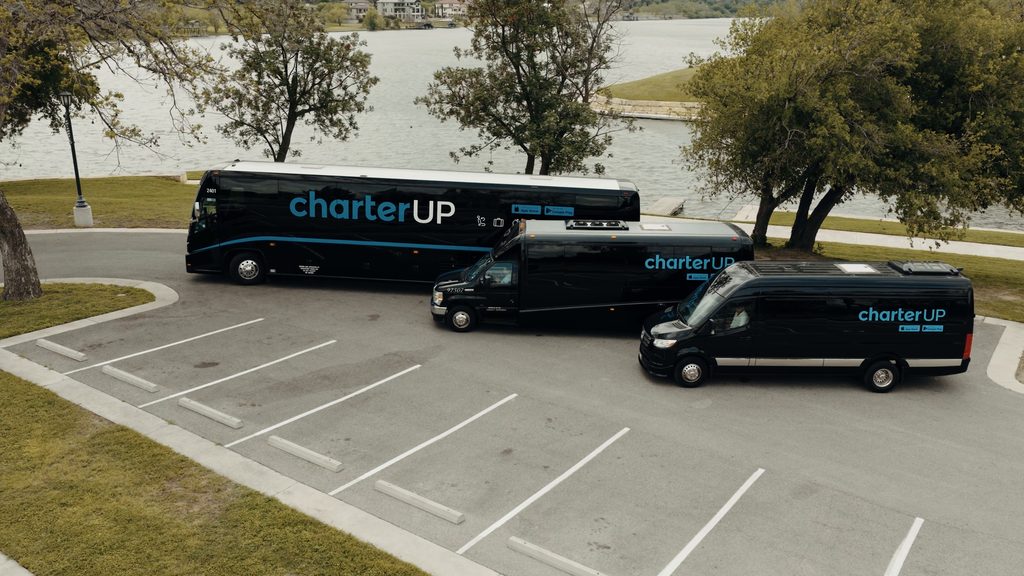
“When the 2012 DNC wanted 60 buses, I was lucky if a bus company even answered the phone,” Harris says. “When they did, I had no idea if the price I was getting was market price or if it was completely above market. I didn’t know what the quality of the bus would be. I didn’t even know if it would show up.
“It could take days to get a bus secured. It was a very manual process with a lot of back and forth. I thought there just has to be a better way to streamline this whole process.”
Today, two main segments make up CharterUP’s business.
The first is acting as an on-demand bus charter platform, letting users hire a bus for when they want one.
What that looks like in practice is a customer clicking onto the CharterUP platform and seeing all of the bus companies available in real time. CharterUP offers the operator which best meets the customer’s requirements. Various factors feed into the decision-making from price, availability and proximity to route planning, accessibility and supply and demand dynamics. The request is made to the operator through an automated process, the operator accepts in “less than a minute” – and with a 90% overall acceptance rate, according to Harris – and CharterUP takes its take rate.
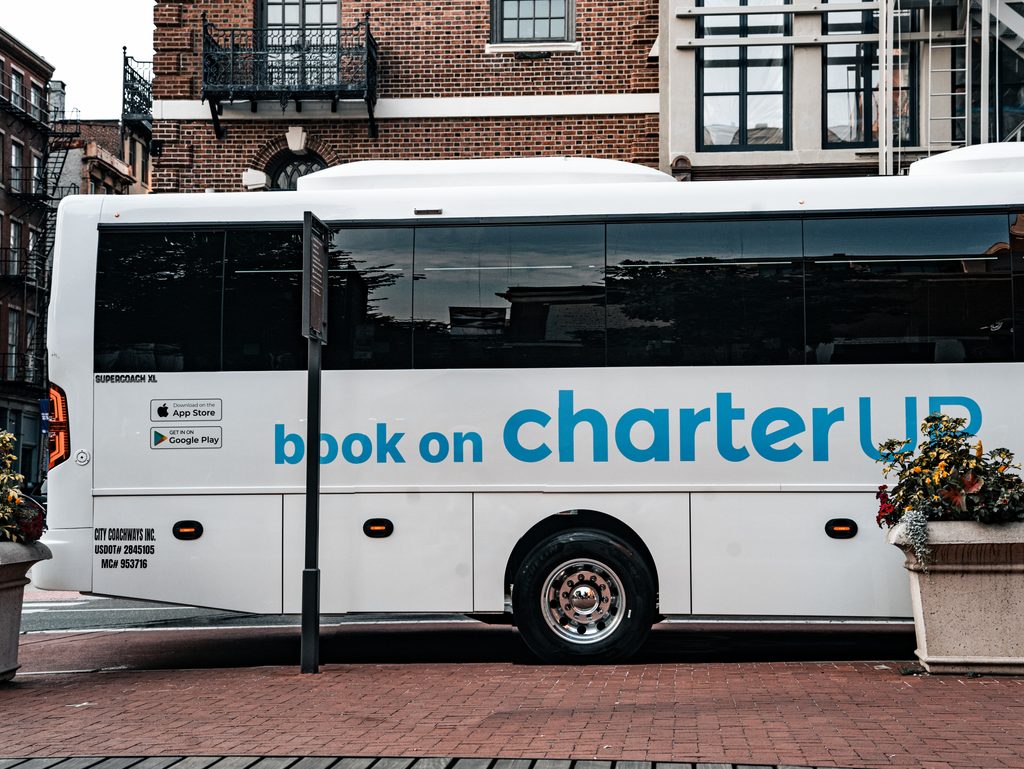
The enterprise market is CharterUP’s second segment. This sees the firm partner with transit agencies, Fortune 500s, universities, corporate campuses and airports to launch more permanent group transportation services like shuttles that serve fixed routes and stay in action for years.
“We serve more Fortune 500 companies than any other bus company in the United States and Canada,” Harris says.
From a transaction standpoint, it’s the on-demand charter service that makes up most of the business, spanning customers like schools, athletic teams, nonprofits and churches seeking one-off group transportation.
“From a dollar standpoint, the fastest-growing segment is our enterprise partnerships,” Harris says. “This has become more than 50% of the business.”
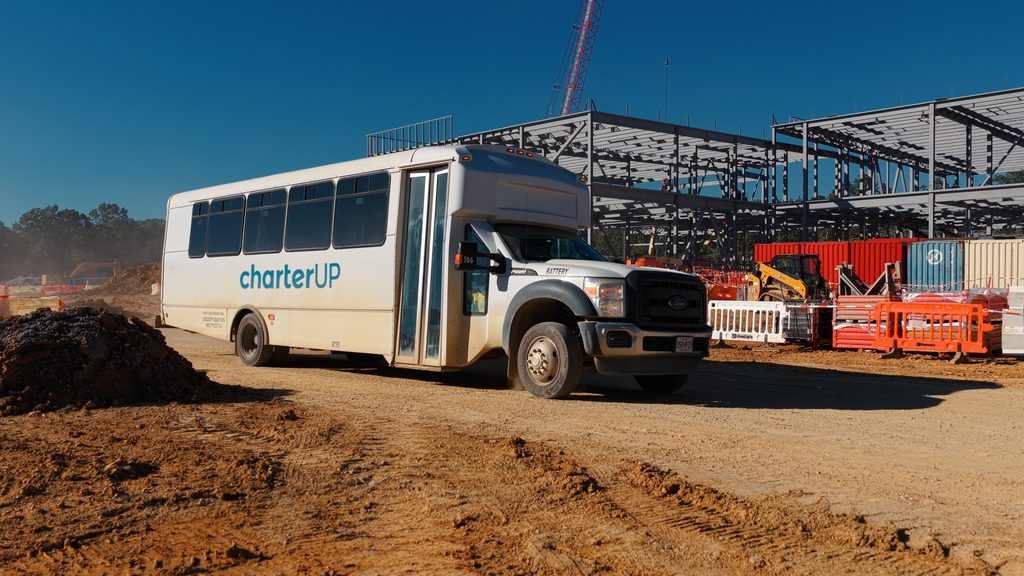
Combined, the two verticals saw CharterUP surpass 50 million miles travelled through its platform to date this year. This is not just a milestone, he says. This is a millions-backed dataset that strengthens the company’s ability to forecast demand, optimise pricing and routing, select operators and maintain service quality.
In other words: “This is intel. This is intel that no one else can get their hands on. It’s very proprietary to us.”
Venturing into autonomy
CharterUP’s next phase of business is autonomy.
Earlier this year, the company announced its partnership with Benteler-owned Holon to add its 15-passenger autonomous shuttles to the platform. Deployments of the Holon shuttle are being driven by customer demand, Harris says, with no specific locations announced yet. Initial rollouts are set to focus on markets where CharterUP already operates shuttle networks like at airports, campuses, transit agencies and with private-sector partners.
Holon is not CharterUP’s only AV move. Harris says the company has partnered with another self-driving maker for group transport but didn’t disclose who. According to him, there’s a fleet of over 50 autonomous shuttles to be deployed “any day now” with two contracts signed in California.
“One contract is with a California airport for 32 vehicles. The other is with a California transit agency for another 20 autonomous shuttles.”
CharterUP’s whole approach to autonomy takes a different direction to the robotaxi developments that continue to make global headlines. It’s not a race to deploy the most AVs, Harris says. It’s not a leaderboard scored by the number of markets. The company doesn’t have any goals for how many AVs it wants to deploy by the end of the year.
“Autonomy is not the product,” Harris says. “Better transportation is the product.”
What that means is a relatively slow and modest addition of autonomous vehicles to the platform as CharterUP introduces autonomy route by route – on fixed routes – and alongside human-driven vehicles to gauge and win public trust. Customers want reliable service, shorter wait times, better accessibility and the best cost – or as Harris puts it, “the vehicle is just one component”.
The Holon partnership feeds into that vision for CharterUP. With L4 autonomy, it can’t operate anywhere. It can only perform driving tasks under defined conditions, within a domain specified by geography, speed, road type, weather, time of day and other conditions. The vehicles have a maximum speed of 37mph, an automated ramp with wheelchair space, auditory and visual assistance.

According to Harris, the Holon partnership is a deliberate decision to assess what autonomous vehicles can actually add to group transportation, feeding into the reliability, accessibility and cost requirements.
“The conversation about autonomy becomes meaningless if we’re not able to deliver our customers the service they want and need right now. We have to make sure we execute on that and earn our right.”
That doesn’t mean to undermine the potential of autonomy. Harris says that, whilst making group transport autonomous will be a much slower process than doing so for rideshare, it will arguably serve an even bigger purpose.
“Most autonomy conversations and investments have currently focused on turning four-seat vehicles into driverless four-seat vehicles.
“But the greater opportunity is in shared large transportation.”
Why? For Harris, the answer is in serving a larger number of passengers at once and offering them what should be a safer mode of travel. And it’s also in addressing a critical labour shortage the US is experiencing in its public transport services.
According to the American Public Transport Association, 43% of transit workers in 2021 were over 55 years old – nearly double the percentage of the broader transportation sector.
“The workforce is soon going into retirement,” Harris says. “Autonomy is not going to necessarily take away jobs. It’s going to extend service where these agencies cannot consistently staff routes.”
That’s not to say the process will be a low-cost one. Early deployments require mapping, integration, supervision, charging, maintenance and training, all making the near-term economics not particularly appealing.
“But, in the long term, the economic case is a much stronger one. There will be economies of scale as the system becomes more repeatable. You’re going to have a safer service with less of a driver shortage,” Harris says.
“The future is going to be one where most transit environments are operated by autonomous shuttles. But we’re very far away from that.”
But market forces will play out, Harris says. And market forces typically always win.
As CharterUP rounds up what it’s calling a “landmark year” with over 100% year-on-year growth reported, a booming enterprise segment and 50 million miles travelled, the company is now focused on taking its service to more and more cities across North America and facilitating autonomy as it does so.
CharterUP has a big name in the US and Canada. Just this week it expanded into the mid-south with two new offices in Memphis and Southaven. But is the platform destined to stay only on the North American continent?
“No,” says Harris. “We have global aspirations and we’re going to expand into other countries. It may not be next year, but it’s just a matter of time.”