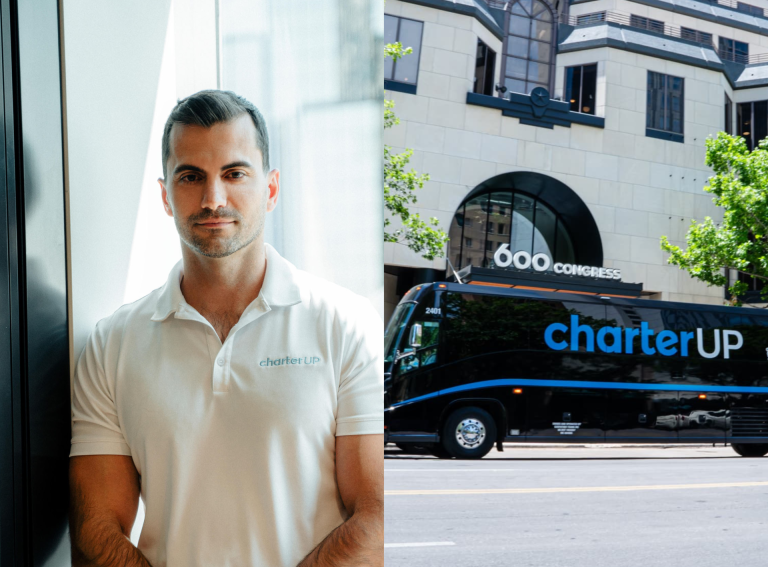
Image credit: CharterUP
American group transportation provider CharterUP has reported 50 million miles travelled across its network.
Founded in 2018, CharterUP acts as a marketplace which delivers on-demand group transportation for universities, transit agencies, airports and communities across the US. The platform lets customers book buses and shuttles on the spot with real-time availability, dynamic pricing and live tracking.
This week, the Austin-based company reported that it has served more than 25 million passengers to date with 10,000 vehicles connected to the platform nationwide.
“Our business is in a very strong position,” CharterUP Founder and CEO Armir Harris told Zag Daily.
Harris said the company has grown “more than 100% year-over-year” over the past several years, though he declined to share detailed financial figures for 2025 or Q1 2026. He said that CharterUP is reinvesting revenue into its workforce, platform and technological capabilities.
“This year alone we’ve closed numerous, long-term enterprise contracts valued in the seven and eight-figures, in addition to our steady marketplace business. Our pipeline only continues to grow.”
Harris said the company’s growth is equally supply and demand-driven, arguing that CharterUP brings visibility to what has historically been “an extremely fragmented and manual market”.
“We bring operators access to demand and job scopes they could not reach on their own.”
A “landmark year” ahead
While Harris declined to reveal specific plans for the rest of the year, he said that 2026 is “shaping up to be a landmark year” for the business.
“Our business has never been in a stronger position both commercially and technically,” he added.
As CharterUP reinvests into its technology, Harris confirmed that a core component will be AI. He said that the company has made “significant investments” in the field across supply and demand matching, its pricing engine and fleet management.
Earlier this year, CharterUP announced a partnership with Holon, the autonomous mobility company owned by Benteler, to introduce self-driving shuttles into its US network.

Although the company declined to share operational or ridership figures related to the rollout, Harris said that the future of group transport will “rely heavily” on autonomous solutions.
“Autonomy remains a core part of our long-term vision,” he added. “Our ongoing investments in AI signal a bit of foreshadowing on where we see the market going. The work we’re doing today on smart dispatch, dynamic routing and predictive operations is the same foundation that will power the autonomous fleets of tomorrow.”
Beyond AI and autonomy, CharterUP is also expanding its focus on the education sector including dedicated products for K-12 school districts, campus transit systems and higher education institutions. The company also plans to strengthen collaboration with municipalities and infrastructure groups on large-scale transit and infrastructure developments.