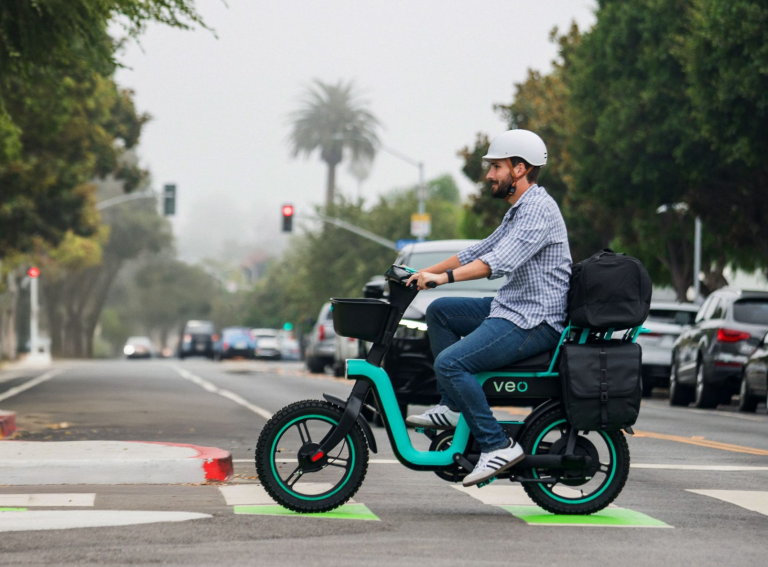
For seven years, Tomás Veloso operated at the centre of Europe’s dockless micromobility expansion. As Director of Micromobility at Bolt, he oversaw the platform’s trajectory from early pilots into an operation spanning 320 cities, 30 countries, 220,000 vehicles and more than 1,000 staff. It was a high-growth, venture-backed expansion built around proprietary vehicles, app-based scale and commercial competition with global giants like Lime.
Veloso has now stepped into a very different arena. Joining Inurba Mobility as Chief Commercial Officer, he has moved from free-floating consumer fleets to long-term municipal concessions, where operators deliver regulated, ten-year bike-share contracts tied into civic transport networks.
Speaking to Zag Daily at the Smart City Expo World Congress in Barcelona, Veloso said the shift reflects where European urban transit policy is heading as local authorities demand greater operational accountability.
“Bolt was an extraordinary chapter, from launching the first cities with off-the-shelf vehicles not built for sharing, to designing and producing our own hardware and software with the team and leading operations at scale,” Veloso said, adding that it gave him a practical understanding of what makes an operation work on the street, every day: “availability, maintenance, battery logistics, service density, unit economics.”
At Inurba, Veloso is championing a supplier-agnostic model that diverges from the vertically integrated approach of his former employer. Rather than manufacturing proprietary bikes and software in-house, Inurba sources vehicles, IoT modules and docking infrastructure from a network of third-party suppliers, matching equipment to local geography, street layouts and parking requirements.
Inurba’s model starts with the requirements of each city. Terrain, road surfaces, vehicle specifications and parking arrangements all influence the choice of bikes, connected hardware and infrastructure like parking docks. The company selects from a pool of manufacturers instead of relying on a standard range of vehicles for every scheme.
“One size does not fit all in terms of schemes,” Veloso said.
Unlike the short-horizon nature of consumer apps, decade-long municipal concessions mean hardware inevitably dates. Veloso pointed out that battery technology alone evolves drastically within five years, arguing that operators must build multiple replacement options into their supply chains from the start so obsolete components can be swapped without destabilising the entire network or requiring a whole fleet overhaul.
The limits of vertical integration
Veloso challenges the belief that developing hardware and software in-house provides true supply chain sovereignty. With post-pandemic logistics shocks and geopolitical trade tensions reframing industrial strategy across Europe, he argued that so-called full-stack operators remain subject to the same global bottlenecks as everyone else.
“You might still buy from China, produce in Taiwan, and then assemble in Europe,” Veloso argues. “The difference with our model is not vulnerability; it is transparency. We simply say to the cities: here is a pool of suppliers, so if one is not working, we can switch.”
By unbundling the technology stack, Inurba intends to insulate municipal clients from technological lock-in. If an IoT firmware vendor stalls, or a motor manufacturer ceases production, the contract incorporates open documented APIs and pre-negotiated secondary sources, allowing parts to be replaced without retiring the fleet.
The company applies a similar principle to software. Its objective is to let municipalities adapt services as their requirements change, without becoming wholly dependent on a single operator’s technology.
Applying venture discipline to public contracts
Open architecture alone does not guarantee a functioning transit service. Veloso argues that public concessions fail without the operational rigor honed in the venture sector.
Selling a city a ten-year contract is one thing, he notes, but operating it is another. “Looking at the APIs, the user metrics, the city metrics and the compliance you need to deliver on the ground requires real operational efficiency.”
At Inurba, his focus is on bringing that discipline directly into municipal bids and daily operations.
Veloso highlights that sustainable schemes depend on transparent metrics, from bike availability and rebalancing for peak hours to fast repairs and predictable maintenance costs over a vehicle’s lifespan. Over the next year, the company plans to introduce shared performance scorecards so transport authorities can track service levels against raw operational data in real time.
The group’s flagship partnership in Helsinki illustrates the scale Inurba wants to replicate. Running the Finnish capital’s network since 2016, the operator has expanded the system from 500 bikes and 50 stations to 4,500 bicycles across 450 physical and virtual hubs, maintaining agreed service levels over a sustained decade-long deployment.
The pending procurement shift
Veloso anticipates that Inurba’s commercial push will coincide with a wave of contract renewals across Europe. Over the next two to three years, he expects a marked increase in tender activity in markets including Germany, Poland and the UK, alongside further investment in Spain, as earlier long-term agreements expire.
Historically, many municipal schemes were awarded to outdoor advertising companies, which Veloso said often left local authorities feeling captive to a single operator. Over the past three years, however, cities have sought to reassert control over street operations by capping fleet sizes, restricting or banning e-scooters in favour of e-bikes, and relying on virtual stations to prevent clutter without heavy infrastructure costs.
Rather than returning to fully state-subsidised networks or relying entirely on venture-funded, free-floating fleets, Veloso expects future tenders to lean towards public-private partnerships. Under this structure, fixed public funding underwrites daily commuter services, while commercial revenues from tourists and occasional riders help balance operating costs.
“The industry, for me, is going to be more leaning into these public-private partnerships with the cities, and less on exclusively public subsidies, and less as well on just pure free-floating in between,” Veloso said.
Backed by investment firm VisionEdgeOne, which owns Inurba and added Swiss operator PubliBike to the group this year, the company plans to target selected tenders across both established and untapped European markets.
“We’d rather win the right contracts and run them excellently than chase volume,” Veloso said.