Image credit: Glovo
Restaurants around the world are adapting to a new order of business, one that involves pings, chimes and bells from numerous delivery platforms.
Many restaurants struggle to anticipate demand from these different food delivery apps and the endless stream of customers they bring. There often isn’t a simple or cohesive solution for restaurants to manage multiple apps, delivery drivers, and expected orders.
Deliverart, a Rome-based start-up that aggregates orders from food delivery platforms into a single screen, aims to provide that solution with tech startup Switch. In a new partnership, the pair bring AI-powered demand forecasting to restaurants and operators for faster, smarter deliveries.
Decoding the difficulties of restaurant delivery
Founded in 2016, Deliverart set out to help small and medium-sized restaurants manage on-demand orders.
Having spent years working in restaurants, CEO and Co-Founder Bryan Natavio got a first-hand glimpse into the reality of the hospitality industry, with many restaurants lacking the tools to adapt their businesses to evolving consumer behaviour and the rise of on-demand delivery.
The average restaurant today partners with multiple platforms to bring in delivery orders. In Italy, Just Eat, Glovo and Deliveroo are some of the major platforms sending in orders and delivery drivers that restaurants must fulfill. One of the most essential challenges to crack is timing so that customers can enjoy the fresh, warm meal they paid for.
To simplify the fulfillment process for restaurants, Deliverart integrates Italy’s food delivery services into a single platform, enabling restaurants to see all of their on-demand orders on one screen.
The partnership with Switch now adds another layer of expertise to Deliverart’s platform, streamlining orders for restaurants, forecasting demand, and delivering sophisticated insights.
Leveraging AI for restaurants
Deliverart knew that AI could substantially uplevel their offering and improve outcomes for restaurants.
As restaurants handle orders from multiple delivery systems, Natavio says it’s become “increasingly difficult” to coordinate drivers, routes, and timings across them
“Switch’s AI tooling enables us to provide our restaurant partners a greater degree of dependentability. Timing and accuracy are crucial in delivery, and Switch enables us to perfect both,” Natavio tells Zag Daily.
Before using Switch, much of Deliverart’s coordination was done by hand. “It took a significant amount of time and was prone to human error for our team to reconcile data from multiple delivery systems and continuously monitor various dashboards.”
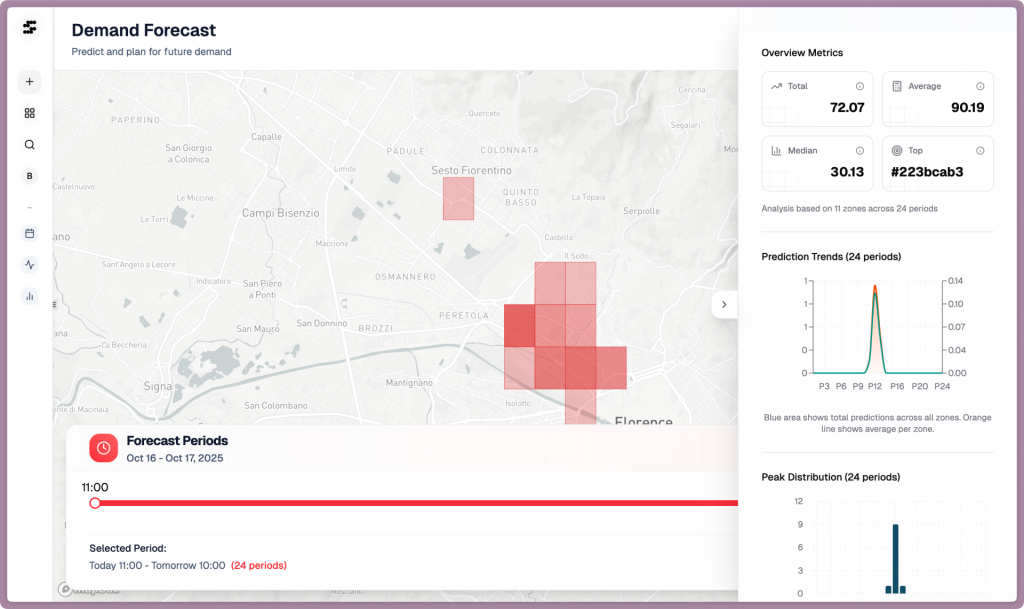
Meanwhile, early tests show that using Switch’s AI tool has achieved over 92% accuracy in predicting demand for restaurants. In turn, this leads to greater operational efficiency with less rider burnout, reduced cost per delivery as a result of intelligent driver allocation, and precise ETAs.
“Ultimately, the goal is to simplify our restaurant partners’ lives and provide their end customers with a more reliable and consistent delivery experience,” Natavio says.
What’s in it for operators?
The food delivery operators integrated into Deliverart’s platform can also directly benefit from AI.
Like restaurants, the main challenges operators face is predicting demand. This entails planning for the volume of orders, the number of orders per pick-up, and the number of drivers.
AI-powered forecasting offers the potential of boosting reliability, reducing rider burnout, and shrinking costs by building a sustainable business model without the guesswork.
To predict the future, insights from the past must be leveraged. Switch’s advanced analytical tools provide operators with historical delivery data which can be visualised by time, location, and rider performance to inform future strategies. “The platform also provides real-time metrics, such as active deliveries in progress and the number of riders currently on shift, allowing managers to understand both historical patterns and live operational status at a glance,” Switch CEO Matteo Forte tells Zag Daily.
“This visibility enables true operational planning. We can determine the optimal number of vehicles and riders needed, identifying the most efficient routes, and allocating drivers and vehicles strategically across different zones of the city.”
Embedding AI into last-mile logistics allows operators to move from the reactive emergency model that defines traditional delivery, to a predictive and more sustainable model that supports key business metrics.
“Last-mile delivery operators are typically trapped in a constant action-reaction loop,” Forte says. “Their operational data is scattered across multiple tools and platforms, making it impossible to see the full picture or plan effectively for upcoming shifts. They’re essentially flying blind, reacting to each delivery wave as it hits rather than preparing for it in advance.
“Switch gives last-mile logistics companies what they’ve always needed – the ability to anticipate challenges and work smarter, not harder.”
Adapting AI for both mobility and logistics
Until now, Switch has largely focused on optimising operations for urban mobility, from car-sharing to micromobility fleets.
Despite this focus, Forte was keen to build a platform that could be easily adapted for other urban essentials, such as last-mile transport logistics.
Switch’s platform didn’t need to be rebuilt or customised to support delivery services. “The forecasting engine dynamically generates models based on each dataset rather than using a one-size-fits-all approach,” Forte says.
Moreover, Switch’s simulation engine “creates digital twins that can represent any type of urban fleet whether that’s urban mobility vehicles or delivery vans and bikes.”
Switch worked with Deliverart to ensure their operations dashboard tracked against the metrics most crucial for a delivery business. Switch’s dashboard provides operators with data visualisation, while enabling operators to configure and track their own KPIs.
“A delivery operator defines success very differently from a vanpooling service or a car rental provider, so Switch dashboards are designed to measure what’s most relevant to each business,” Forte says.
For Deliverart, the benefit was a set-up without the fuss. “It never felt like a vendor-client relationship. Instead, it felt like a collaborative effort with a common goal,” says Natavio. “The Switch team worked closely with our developers to ensure a smooth integration. It only took a few weeks, including testing and fine-tuning, from setup to full deployment.”
Meanwhile, the benefit for the end-user is clear: tapping a few buttons on your phone and having a hot meal delivered to your doorstep as if by magic.
Whilst there’s layers of complexity to overcome before the final step in the delivery chain, Deliverart and Switch think AI might just be the solution to boosting operational efficiency, lowering costs, and keeping customers’ bellies full.