Author: Didier Gorteman, Chief Finance & Operations Officer, Ertico-ITS Europe
A privilege of having spent more than 25 years working in Intelligent Transport Systems (ITS) is getting to see unbelievably ambitious ideas become part of everyday mobility.
Watching technologies develop, partnerships grow and the ITS community expand its horizons over that time has been remarkable. It has continually found new ways to make transport safer, smarter, more efficient and more sustainable.
As Ertico marks its 35th anniversary, it is a fitting moment to appreciate just how far that journey has taken us.
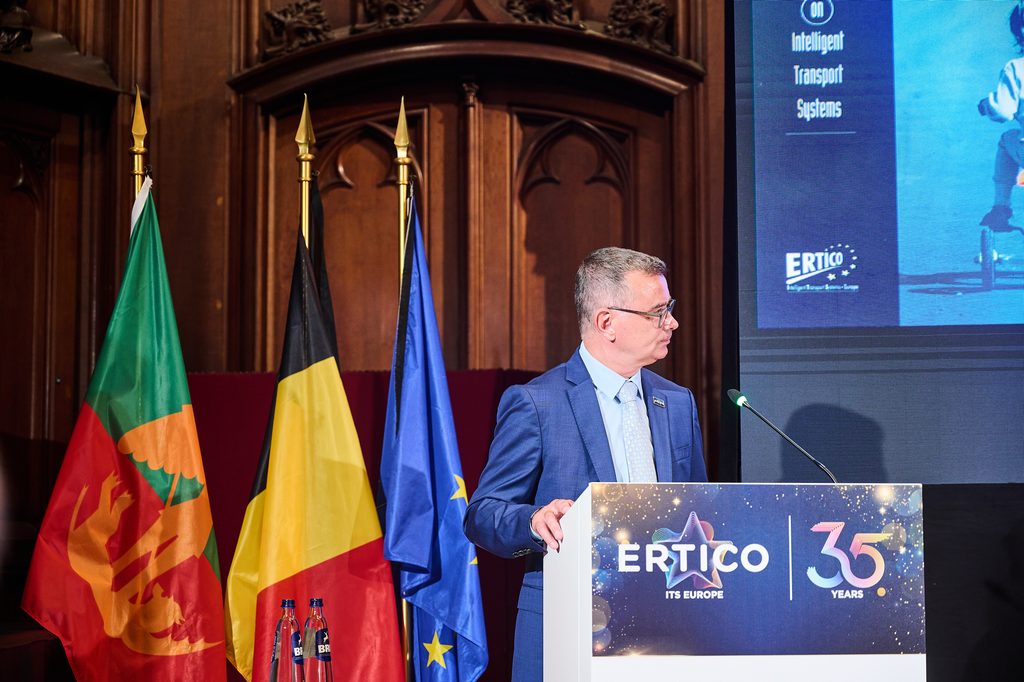
The ITS landscape today bears little resemblance to the one I entered more than two decades ago. We have moved from a time when connectivity was limited and many digital mobility services were still experimental to one where vehicles, infrastructure, operators and travellers are increasingly part of the same connected environment.
What stands out to me most, however, is not any single technological breakthrough. It is how ITS has grown from a collection of promising innovations into an increasingly interconnected part of how our transport systems function. That progress has been made possible through dedicated collaboration, new partnerships and teamwork.
When ideas become reality
The history of ITS is full of ambitious ideas that have gradually found their way into the real world.
Over the years, European research and innovation programmes have explored everything from advanced traffic management and digital maps to vehicle connectivity, road safety services and, more recently, automated mobility and artificial intelligence.
Some developments progressed quickly. Others required more time, cooperation and experimentation. Together, they have built the foundations for many of the services and capabilities we rely on today.
This is an important part of the innovation journey. A successful demonstration is an essential first step but bringing a solution into everyday use requires much more. As technologies mature, the questions naturally expand: how will they connect to existing infrastructure? Can different systems exchange information? Who will operate and maintain them? Which standards are needed? And how can they be deployed across different cities, regions and countries?
I have seen this evolution many times during my years at Ertico.
eCall is one example. The concept began within Ertico through the eSafety Forum and was developed further through three subsequent projects, ultimately contributing to the mandatory deployment of eCall in all new vehicle types. For the driver, the principle is simple: if a serious accident occurs, the vehicle can automatically contact emergency services. Making that possible across Europe, however, required the automotive sector, telecommunications providers, emergency services, public authorities and many others to work together.
Its development illustrates something that has become increasingly important as ITS has matured: the greatest progress often comes when different parts of the mobility ecosystem combine their expertise around a common objective. For 35 years, this has been at the heart of Ertico’s role: acting as a catalyst between sectors to help turn shared ambitions into practical results.
From connecting technologies to connecting sectors
This is perhaps the most significant evolution I have witnessed.
The early years of ITS were often centred on particular technologies or applications. Today, the boundaries are much less clear. A connected vehicle depends on digital and physical infrastructure. Traffic management increasingly draws on data from multiple sources. Automated mobility brings together roads, communications, regulation and safety. Electric mobility creates new connections between transport and energy.
We are therefore no longer simply connecting technologies. We are connecting sectors, organisations and, increasingly, entire systems.
That creates enormous opportunities. Information can move faster. Infrastructure can become more responsive. Vehicles can better understand the environment around them. Transport networks can be managed with a much richer picture of what is happening in real time.
The opportunity now is to make these capabilities work together even more effectively. For me, this is where the original purpose behind Ertico remains remarkably relevant. When the organisation was created in 1991, one of its central ambitions was to help bridge the gap between research and deployment by bringing together the different actors needed to make ITS work in practice.
The technologies have changed beyond recognition. The value of bringing people and sectors together has only grown.
A Congress floor tells its own story
You can see this evolution particularly clearly at the ITS Congresses.
The first ITS World Congress took place in Paris in 1994. Compare the subjects discussed then with the conversations taking place today and you have a snapshot of how significantly the sector has expanded.
Traffic management, navigation and traveller information remain part of ITS but they now sit alongside connected and automated mobility, multimodal transport, digital infrastructure, data sharing, artificial intelligence, decarbonisation and many other areas.
Having helped organise and attended many Congresses over the years, I find the exhibition floor itself tells part of the story. New technologies appear, new organisations become involved and, perhaps most importantly, new connections are made between them. Crucially, we move beyond concepts to real demonstrations of systems and services being deployed in practice.
A road operator is now discussing data with a vehicle manufacturer. A city may be working with a technology company on automation. Researchers, policymakers, infrastructure providers and mobility service providers increasingly find themselves addressing different dimensions of the same opportunity.
When the ITS World Congress comes to Birmingham, UK, in October 2027, we will see another snapshot of where that evolution has taken us. It will be an opportunity to see emerging technologies and demonstrations in action, exchange experiences from across the world and explore how the next generation of ITS can move from possibility to practical implementation.
The next step is making everything work together
Looking ahead, there is a great deal to be excited about. Artificial intelligence is opening new possibilities for how we understand and manage transport. Vehicles are becoming increasingly connected, safer and more automated. Infrastructure is becoming more intelligent, while data is giving us a deeper understanding of how people and goods move.
After watching this sector evolve, what inspires me most is not necessarily one technology in isolation but what becomes possible when these developments come together.
The next generation of mobility will increasingly see vehicles communicating with infrastructure, transport connecting with energy and digital networks and data moving securely between organisations and across borders. These developments give us new tools to make roads safer, networks more efficient, transport more sustainable and mobility work better for people.
This is where I believe the next chapter of ITS becomes particularly interesting
Over the years, I have seen technologies arrive and evolve, priorities shift and new possibilities emerge. What has remained consistent is the ability of this community to bring different expertise together and turn ambitious ideas into practical solutions.
Thirty-five years ago, many of the capabilities we now consider normal would have seemed extraordinarily ambitious. There is every reason to believe that when we look back 10 or 20 years from now, we will be able to say the same again.
After more than 25 years in this field, that is perhaps what gives me the greatest confidence in what comes next: we have seen what becomes possible when ideas, commitment and collaboration come together through real teamwork. Behind every deployment, demonstration and milestone are people making it happen, from the Ertico team to the many teams across our Partner organisations and the wider ITS community. Their expertise, commitment and willingness to work together are what continue to turn ambitious ideas into impact.