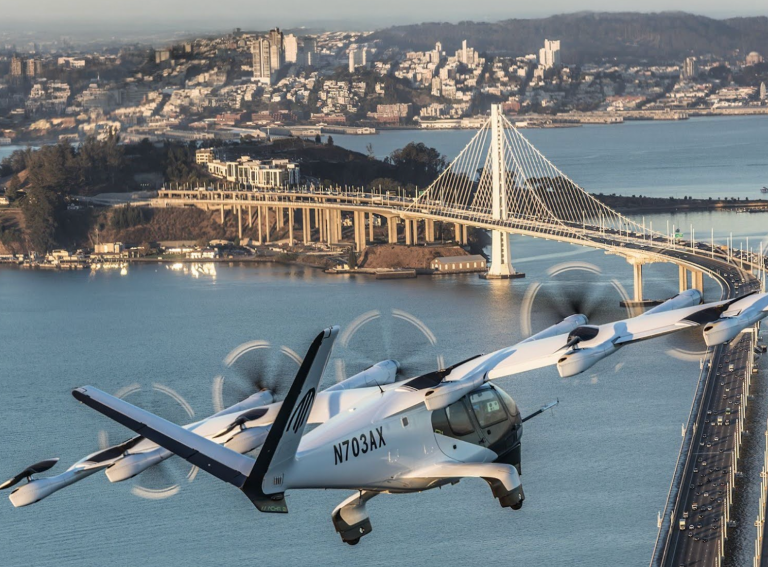
Electric air taxi developer Joby Aviation has agreed to buy helicopter taxi service Blade Air Mobility’s passenger business for up to $125 million.
The deal gives Joby access to routes, customer networks and terminals in key markets including New York and Southern Europe. According to analysts, this move speaks as much to the sector’s difficulties as it does to Joby’s ambition.
Accelerating market entry
Blade’s passenger arm operates helicopter and charter services, flying more than 50,000 passengers last year between Manhattan, JFK and other short-hop destinations, as well as luxury routes in the south of France.
The acquisition includes 12 terminals and the Blade brand, with founder Rob Wiesenthal set to continue leading the business under Joby’s ownership. The organ transport division, which generated nearly 60% of Blade’s $250m revenue last year, remains separate and will be renamed Strata Critical Medical.
Joby will pay up to $125m in cash or stock, with $35m of the total tied to performance milestones and key staff retention. The company says the deal will speed up its plans to launch passenger services for its S4 eVTOL aircraft, starting in Dubai next year before expanding globally.
“Over the last decade, Rob and the team at Blade have built a world-class passenger experience,” said Joby CEO JoeBen Bevirt. “This is a launchpad to accelerate the scale-out of our quiet, electric aircraft once certification is secured.”
Paul Pocialik, a UAM and UTM consultant, told Zag Daily that this move highlights a wider challenge in advanced air mobility. “I think eVTOL players are realising that just about everything needed to stand up a business focused on UAM is harder than originally expected,” he said. “The acquisition helps perpetuate Joby’s story and speeds time-to-revenue in the face of infrastructure and other challenges.”
Joby has seen its stock price surge in recent months, lifting its market cap to new highs. Analysts say that momentum helps it raise cash to fund heavy R&D and now acquisitions. “It behooves Joby to keep this up since it makes it easier to raise capital through either debt or an equity offering,” Pocialik noted.
Price tag raises eyebrows
Blade’s passenger business had been unprofitable since its 2021 IPO, though it recorded its first adjusted EBITDA profit of $100,000 in Q1 2025, driven by cost savings and operational efficiencies.
Meanwhile, its medical arm has continued to drive the majority of growth, accounting for around 60% of Blade’s 2024 revenue. Pocialik noted that high-growth aviation tech companies can be valued at up to 10x revenue, suggesting that a sale price as low as $125 million for Blade’s passenger division appears unusual.
“This doesn’t appear to be a distress sale, so I’m thinking Blade views their medical transport business as a better and lower-risk opportunity than the passenger side,” he said. “Joby has a clear need for the HNWI and business customer set loyal to Blade, so this might be the best time for Blade to slice this piece off and monetise it.”
Industry insiders also note the deal does not give Joby exclusive rights to New York’s heliports or unique real estate. Blade’s lounges are low-cost, portable setups on publicly accessible pads, infrastructure that rivals could replicate quickly.
A costly bridge to certification
Both companies are loss-making. Joby, which went public in 2021, employs over 2,000 staff and continues to burn cash on certification and manufacturing. FAA approvals for its S4 aircraft are unlikely before 2027, meaning US operations could still be years away. The Dubai launch target for 2026 will test whether the model can scale internationally.
Even so, the purchase may help Joby rehearse operations and build brand awareness ahead of certification. The company plans to integrate its ElevateOS software, inherited from Uber, into Blade’s services to improve scheduling and customer experience.
Future deals of this type are unlikely, Pocialik believes, because few operators have Blade’s scale and most eVTOL manufacturers are not pursuing a combined OEM-operator model. “You might see more partnering activity in regional air mobility where there are currently more operators that provide commercial service,” he said.
For now, the $125m purchase gives Joby a marketing narrative, early access to customers, and terminals in strong markets.