London and Paris are leading the way in Europe’s shared bike boom, according to Fluctuo’s 2024 European Shared Mobility Annual Review.
Of all the shared bike trips that took place in Europe last year, one in three took place in either the UK or the French capital.
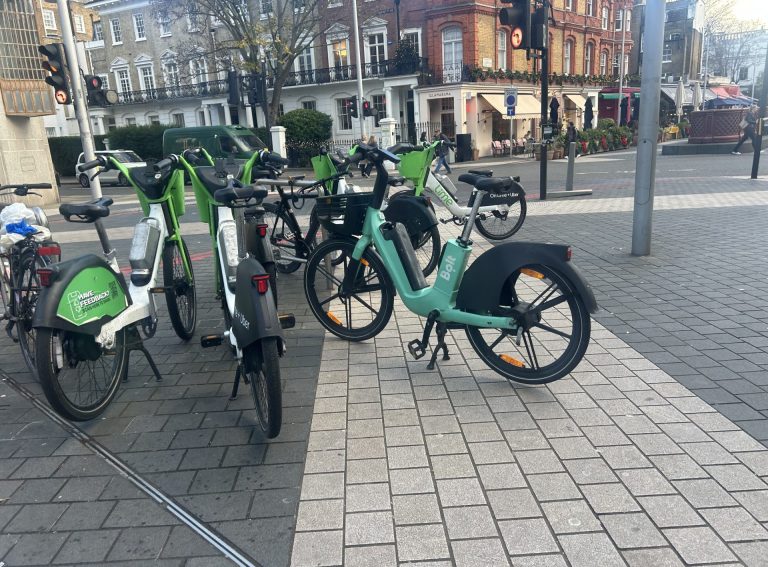
Paris’ Vélib’ bike share system claims the title of Europe’s most used shared mobility service, recording 49 million rides last year. Meanwhile, London boasts nearly one-third of all dockless bike trips in Europe, generating 29 million trips.
On the success of bike sharing in the French capital, Fluctuo CEO Julien Chamussy told Zag Daily: “Paris has had its public bike system Vélib’ since 2007 but, despite some initial problems when the contract was renewed and taken over by Smovengo in 2018, it has become the most used bike system in the world, outside of China.
“The success is down to the population density of Paris, but also the station density and fleet size – it’s a convenient service to use, there are always bikes available, and nearly always docking stations available to park in. It is also very cheap to subscribe, and users can get unlimited rides for less than €10 per month.
“Another factor is the political will of Paris and Mayor Anne Hidalgo to promote cycling and reduce car usage. Paris has become a dream for cyclists, and ridership is growing fast.”
Paris also ranked as the top performing city for bike sharing in Cycling Industries Europe’s Shared Ambition report, which benchmarked the performance of bike sharing across 148 EU cities in 2023.
In contrast to Paris’ high population density, London has a smaller public bike share scheme that is spread over a larger surface area. Julien notes that as station density is more sparse, the service could be conceived as “less convenient” than in Paris.
Nevertheless, in pointing to dockless bikes specifically, Julien believes the relationship between operators and London boroughs have played a large role in the success of bike share schemes.
“Dockless bike operators have been incredibly successful because they have been allowed by the boroughs of London to deploy bikes at scale. There are now more than 30,000 dockless bikes in London whereas in Paris dockless operators have been limited to 18,000 (soon to be 15,000). This has made using shared bikes incredibly convenient in London, and operators and residents are really seeing the benefit.
“London will renew its bike sharing system this year, so it will be interesting to see whether the approach to the station-based or dockless system will evolve over the next 12 to 18 months.”
Julien believes however that both dockless bikes and station-based systems have a place in every city. “Both cities are proof that dockless and station-based models can work, but they both require the right conditions to be successful.”
The wider shared mobility picture
Fluctuo’s European-wide study found that there were 940,000 shared vehicles in 2024 which generated 640 million trips and €2.1 billion in revenue.
The German capital of Berlin tops the leaderboard for having the most shared vehicles in Europe, with 59,000 across its city.
Shared mobility ridership in Europe grew 5% in 2024, despite the overall fleet size decreasing 4% since 2023.
Focusing on dockless bike fleets specifically, ridership surged by 58% alongside a fleet increase of 18%. This takes forward the trend found in Fluctuo’s 2023 Annual Review which revealed that dockless bike ridership increased 54% alongside a 50% fleet increase.
Scooter fleets fell 16% in 2024 with a ridership reduction of 9%. However, scooters still make up 47% of all shared vehicles.
Lyft Urban Solutions was one operator highlighted by the report for making strides with its bike sharing footprint, having deployed more than 42,800 bikes and 2,900 across Europe since its first equipment launch in London in 2010.
Today, Lyft Urban Solutions’ equipment powers bikeshare systems in 18 European cities, and the operator is facilitating the electric shift with 51% of its bikeshare fleet deployed now electric.