London’s Walking and Cycling Commissioner Will Norman has branded the UK capital’s dockless e-bike system “a mess” at today’s London Assembly Transport Committee meeting.
The hearing comes as the government prepares to introduce a new licensing regime for shared micromobility services under the English Devolution and Community Empowerment Act. The legislation establishes TfL as the licensing authority for Greater London, but the detailed rules still need to be set through secondary legislation.
“You ask for my view, I think it’s a mess,” Norman told the London Assembly Transport Committee on Thursday. “Nobody wants it to work like this. I spend a lot of time talking to boroughs, the Mayor, the Department for Transport, people on the ground, disability groups, and cycling groups. Everybody thinks this system is not working.”
London’s dockless e-bike market is operating without a consistent regulatory framework, leaving boroughs reliant on voluntary agreements with operators and Transport for London (TfL) without formal licensing powers.
“We rely entirely on the goodwill of the companies”
The current system is built around agreements between individual operators and London’s boroughs, with different rules covering fleet sizes, parking, fees and enforcement.
Helen Sharp, TfL’s Micromobility Lead, described management of the market as “piecemeal”, while Councillor Paul Osborn, Chair of London Councils’ Transport and Environment Committee, said boroughs were effectively relying on operator goodwill.
“The main challenge is the complete lack of any legal basis to enforce,” Osborn said. “If companies choose not to abide by agreements, our powers to enforce against e-bikes are very limited.”
Operators echoed the case for a more consistent framework.
Georgia Heathman, Public Policy Manager UK and Ireland at Bolt, described the current system as a “postcode lottery”, while Voi’s Harry Foskin said the company’s London operating map was like “Swiss cheese”.
The challenge for policymakers is how to create a London-wide system without removing boroughs from decisions about their streets.
Osborn warned that some outer London boroughs do not currently have dockless e-bike schemes and are not keen to have them imposed, while TfL stressed that boroughs would continue to be involved in the new regime.
Lime’s Alice Pleasant said the operator also supports a single London-wide framework, but warned that parking capacity would need to grow with demand.
“We’re going to ultimately strangle the growth”
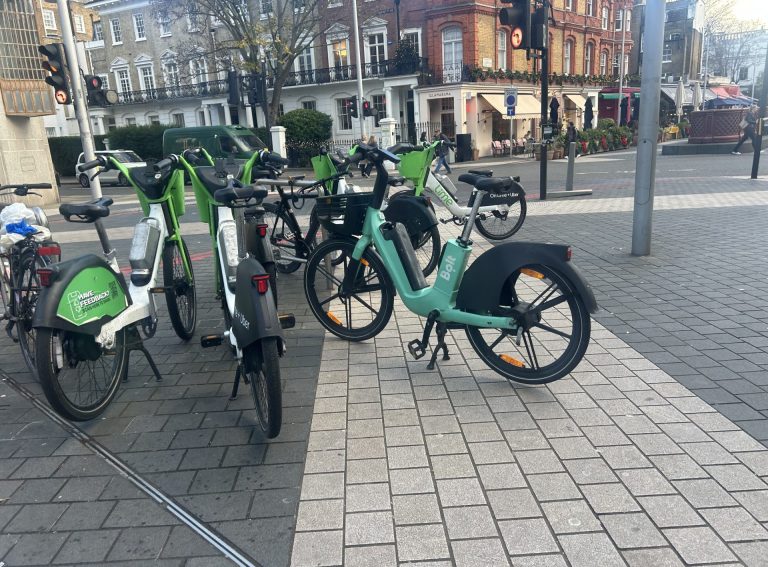
The regulatory problem is colliding with the physical limits of London’s streets. Forest said it now operates around 20,000 bikes across 20 boroughs, but parking provision has not kept pace with the growth of shared cycling.
Alex Berwin, Forest’s Vice President of Public Affairs, said the company had seen fees rise sharply in some boroughs without a corresponding increase in parking capacity.
“We’ve had a 400% increase in fees in the last two years in one borough, but around a 50% increase in bays,” he said, adding that another borough saw “a 277% increase in fees, but a 6% increase” in the number of parking bays available.
“We really need to see more parking now, and otherwise we’re going to ultimately strangle the growth of the scheme,” he added.
TfL said it is already funding boroughs to deliver around 36,000 e-bike parking spaces across London, alongside further work on the TfL Road Network and around transport hubs.
The hearing exposed a tension that the new licensing regime will have to resolve. Operators want enough parking to support growing fleets, while boroughs need control over how much street space is given to shared bikes and where it is located.
“It cannot be managed vehicle-by-vehicle”
Norman said he had seen the impact of poorly parked bikes while working with people with visual impairments and mobility challenges. He pointed to London’s e-scooter trial, where operators are subject to a specific regulatory framework, as an example of how licensing conditions can be used to enforce compliance.
TfL’s Christina Calderato said the answer should not be to chase individual bikes and individual riders indefinitely, but to use operator data to identify systemic failures and place the responsibility on them.
“Once legislation is in place, we should be getting real-time data from operators,” she said. “If there is a breach, instead of chasing an individual fine on a single bike that might not change behaviour, we can use the licensing regime to enforce systemic accountability on the operators themselves.”
The new legislation already provides for regulations covering information-sharing, licensing conditions, financial penalties and the suspension or revocation of licences. It also creates a legal duty for licensing and traffic authorities to cooperate on micromobility parking.
That leaves the detail of how those powers will actually work as the next major question.
Osborn cautioned against treating licensing as a complete solution.
“I’m not convinced a London-wide licensing scheme is a silver bullet,” he said. “You don’t need a complex regime to know that ‘don’t block a fire exit’ or ‘don’t leave a bike lying in the middle of the pavement’ are simple rules.”
The committee is now looking at more than whether London should get a single set of rules. The bigger question is whether the new framework can give TfL and the boroughs enough power, data and street capacity to make those rules work.