Uber has struck a deal worth up to $1.25 billion with electric vehicle maker Rivian, agreeing to purchase an initial 10,000 fully autonomous vehicles with the option to buy a further 40,000 from 2030.
Made up of Rivian’s R2 SUV vehicles, the fleet will be deployed across 25 cities in the US, Canada and Europe by the end of 2031 and will operate exclusively on Uber’s platform.
Uber will make an initial $300 million investment in Rivian, rising to as much as $1.25bn by 2031, subject to the California-based EV maker meeting agreed milestones in its autonomous driving technology. The first vehicles are expected to enter service in San Francisco and Miami in 2028.
“We’re big believers in Rivian’s approach – designing the vehicle, compute platform and software stack together, while maintaining end-to-end control of scaled manufacturing and supply in the U.S,” said Uber CEO Dara Khosrowshahi. “That vertical integration, combined with data from their growing consumer vehicle base and experience managing the complexities of commercial fleets, gives us conviction to set these ambitious but achievable targets.”
The deal provides a significant boost for Rivian which has faced steep losses and a sharp decline in its share price since its 2021 initial public offering. The company expects to sell around 62,000 vehicles this year and has forecast an adjusted loss of up to $2.1 billion.
Rivian has yet to begin production of the R2 SUV with manufacturing expected to start later this year. Its Georgia factory, where the vehicles are set to be built, remains under construction while the company has yet to deploy a fully autonomous system capable of unsupervised commercial operations at scale.
“The partnership will help accelerate our path to Level 4 autonomy to create one of the safest and most convenient autonomous platforms,” said Rivian Founder and CEO RJ Scaringe.
Uber, meanwhile, no longer develops its own self-driving technology, having sold its autonomous vehicle division (Uber ATG) in 2020, instead positioning itself as a platform for a growing network of partners. The company now works with more than 25 autonomous vehicle and robotaxi developers globally.
Building the Uber platform
The Rivian agreement is the latest in a series of partnerships that place Uber at the centre of the emerging autonomous mobility ecosystem without owning the underlying technology.
In a separate deal announced earlier this week, Uber partnered with Nvidia to deploy a fleet of software-defined robotaxis across 28 cities by 2028. Those vehicles will run on Nvidia’s Drive Hyperion platform and its Alpamayo AI model, designed to handle complex real-world driving scenarios. The rollout begins in Los Angeles and San Francisco in 2027 before expanding across North America, Europe, Australia and Asia.
“By expanding our partnership with Nvidia and combining advanced AI with Uber’s global network and operating experience, we are laying the foundation for an increasingly multi-player AV world,” Khosrowshahi said of the deal.
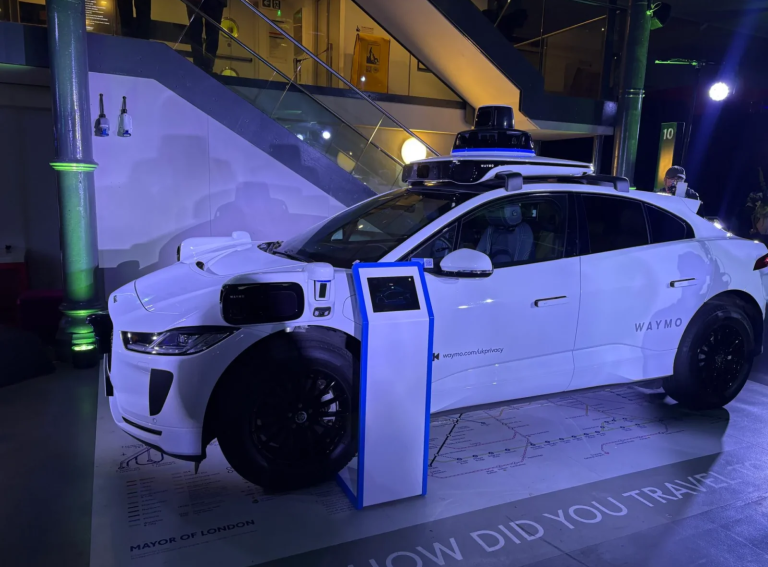
Other recent moves include a partnership with Amazon’s Zoox service launching in Las Vegas, a $300 million stake in Lucid Motors with an agreement to buy 20,000 of its Gravity SUVs and ongoing collaborations with Waymo, Baidu, Motional, and UK startup Wayve.
Across the wider new mobility landscape, Uber has announced collaborations spanning robotaxis, air taxis and delivery drones in 2026.
The deals point to a strategy focused on positioning Uber as the distribution layer of autonomous mobility, while companies such as Nvidia embed themselves at the infrastructure level by supplying hardware and software to automakers and platforms alike.